Your Most Valuable Hotel Asset May Not Be on Your Property
By Michael Tibbetts Founder & CEO, Salterra | August 25, 2026
Disclaimer: The views and opinions expressed in this guest column are those of the author and do not necessarily reflect the official policy or position of Hotel Interactive. The author may have an interest in the products, services, or business entities referenced in this article. Hotel Interactive is not responsible for the opinions or factual assertions made by the author.
Every hotel owner understands the capital plan.
Roofs get inspected. Air conditioning units get serviced. Furniture, fixtures and equipment get a reserve because we know a guest room deteriorates on a reasonably predictable curve. But I’ve learned in developing island resorts that the most important assets may not appear in the capital plan.
The beach. The reef. The bay. The dunes. The mangroves. The water that guests see when they arrive.
My family has been operating resorts in the Caribbean since 1978, originally on Little Cayman and Cayman Brac. Last year, we added a third resort, Salterra, in South Caicos, Turks and Caicos Islands. Through those experiences, I have come to believe that many developers and hoteliers do not fully account for the value of the natural assets surrounding their properties. We tend to treat them as scenery surrounding the hotel.
In many destinations, however, they are actually part of the hotel’s underlying economic infrastructure.
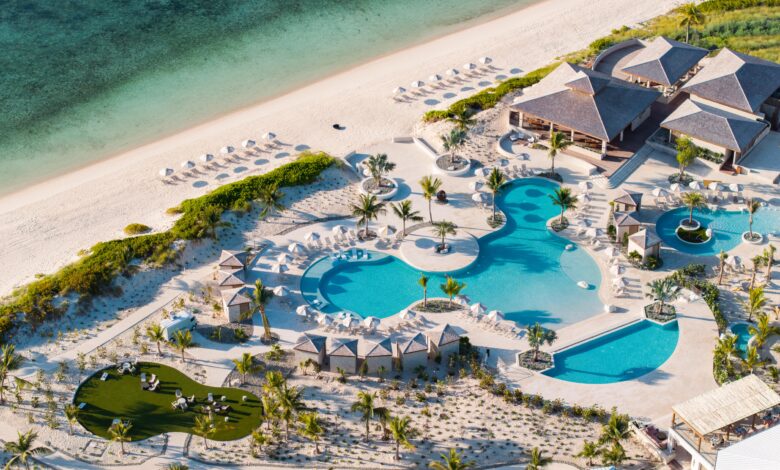
That became particularly clear to me while developing Salterra. The island had little previous resort development and an extraordinary marine environment. As we worked through the traditional development questions — construction costs, utilities, staffing, air service, insurance and demand — an obvious contradiction emerged.
We could assign a value and a maintenance schedule to almost everything we were building. The reef in front of us appeared nowhere in the capital plan. Yet that reef helps protect the coastline. It supports diving and fishing. It contributes to the water quality and marine life that attract travelers in the first place. In other words, one of the assets that is most fundamental to the economics of the resort was valued on our books at zero.
That is not uniquely a South Caicos problem. It exists throughout resort hospitality.
The Asset We Don’t Underwrite
Consider coral reefs first as infrastructure rather than ecology.
Research published in Nature Communications found that coral reefs can reduce incoming wave energy by an average of 97%. The same research estimated that restoring reefs can cost a fraction of constructing artificial breakwaters designed to perform some of the same coastal-protection functions.
Mangroves provide similar benefits, absorbing storm energy while protecting coastlines and property.
A hotel owner would never look at a functioning seawall and conclude that it has no economic value. Yet we often make essentially that assumption about the natural systems performing comparable work in front of our properties.
For years, the distinction may not have mattered very much. If the beach looked roughly the same from one year to the next, it was easy to consider environmental stewardship primarily a corporate responsibility or sustainability issue.
That is becoming harder to do. The financial consequences are increasingly visible.
Sargassum is one of the clearest examples. Massive seasonal accumulations have affected resort destinations throughout the Caribbean and Mexican Caribbean. When beaches become unusable, guests do not distinguish between an environmental condition and the hotel product they purchased.
They simply know the beach vacation they expected is not the one they received.
Rates fall. Cancellations rise. Reviews suffer. Staff and equipment are diverted to cleanup. In severe cases, properties can spend substantial amounts removing sargassum only to have another accumulation arrive the following morning.
An environmental problem quickly becomes a revenue-management problem.
That distinction matters because it changes the question an owner should be asking.
Instead of asking, “How much are we willing to spend on conservation?” the question becomes, “What portion of our revenue depends upon this natural asset continuing to function?”
Those are very different conversations.
Risk Is Beginning to Catch Up
Insurance markets are pushing owners in the same direction.
Anyone operating in a coastal destination already understands what has happened to insurance pricing and availability. Wind exposure, storm deductibles and resilience measures have become material parts of the economics of owning coastal real estate.
What is interesting is that markets are beginning to experiment with insuring not simply the hotel, but the natural systems that protect it.
In Mexico, a partnership involving the state of Quintana Roo, tourism interests and The Nature Conservancy created a trust that purchased parametric insurance covering portions of the Mesoamerican Reef. When Hurricane Delta struck in 2020, the policy generated funds that could quickly be deployed to stabilize and repair damaged coral.
The significance to hotel owners is not simply that someone found a clever way to finance reef restoration. It is the premise behind the policy.
The reef has economic value. Damage to it creates financial consequences. Restoring it quickly has value to the businesses and communities behind it.
Once you accept that premise, the way we think about resort capital expenditure begins to change.
The same evolution is appearing in government policy and investment decisions. Visitor taxes are increasingly being directed toward conservation and climate resilience. Physical climate exposure is appearing more frequently in diligence, lending and insurance discussions.
Eventually, something that affects insurance, revenue and terminal value becomes difficult for capital markets to dismiss as somebody else’s environmental issue.
Sometimes the Environment Even Underwrites Demand
There is another connection that is particularly important in remote destinations: air service.
Establishing scheduled airlift into a small island requires airlines, governments and hotels to make assumptions about future demand. Sometimes those assumptions are supported by minimum revenue guarantees or other financial commitments.
But beneath the spreadsheets is a very simple question:
Why will people make the trip?
In South Caicos, the answer ultimately comes back to the natural environment — the water, marine life, fishing, diving and experience of an island that remains largely undeveloped.
If those qualities deteriorate, destination demand deteriorates with them. The forecast supporting the route becomes weaker. Reduced airlift then makes the destination harder to reach, further weakening hotel demand and rate.
It is a reminder that a natural asset can influence economics far beyond the edge of the beach.
The Property Line Is the Problem
If the business case is increasingly apparent, why does the industry still struggle to respond?
One reason is that the ownership model does not match the asset.
A reef does not stop at the hotel boundary. Neither does a mangrove system, a sediment plume, water quality or a raft of sargassum.
Guests experience a coastline and a destination, not a cadastral map.
That creates an obvious problem for individual owners. A hotel can spend heavily on protecting the natural environment around its property while neighboring properties benefit from the same investment. The operator paying the bill may capture only a fraction of the financial return.
Sargassum demonstrates this particularly well.
Once it reaches the beach, removal is labor-intensive, expensive and potentially damaging. Heavy machinery can disturb nesting areas and remove sand along with the seaweed.
Intercepting sargassum offshore can sometimes be more effective, but doing that requires permitting, equipment, monitoring and coordination at a scale that usually exceeds the ability of a single hotel.
The cheaper solution can therefore be harder to implement because it requires several parties to cooperate.
That may be the most important lesson from efforts such as the Quintana Roo reef trust. The innovation was not simply conservation. It was creating a structure through which hotels, government and other stakeholders could collectively fund something none of them could efficiently accomplish alone.
We have tried to put that philosophy into practice in South Caicos. Through Salterra, our ownership group has invested $350,000 in the South Caicos Coral Reef Consortium, a collaboration with the School for Field Studies, the Turks & Caicos Reef Fund and The Reef Institute. The investment has helped support coral research, in-water nurseries and a solar-powered coral lab and biobank. The consortium is collecting, propagating and outplanting corals with the goal of rebuilding reefs around the island. Hundreds of live corals have already been returned to restoration sites.
Stewardship also means recognizing that it makes little sense to invest in rebuilding reefs while remaining silent when they face avoidable threats. In 2024, we publicly opposed a proposed South Caicos development plan that contemplated canal entrances through the Admiral Cockburn Land and Sea National Park. The Turks & Caicos Reef Fund warned that the dredging required to create those canals could generate sediment capable of smothering coral reefs and seagrass beds vital to fisheries and tourism. After public opposition and a judicial review filed by the Reef Fund, the development plan was quashed and the developer presented updated plans moving the canal entrances outside the national park.
That experience reinforced something I think our industry needs to confront. Development and conservation are not opposing ideas. In destinations whose economics depend on the natural environment, responsible development requires protecting the very assets that made development attractive in the first place.
For hotel owners elsewhere, the appropriate vehicle may be a hotel association, tourism board, conservation trust, improvement district or public-private partnership.
The structure matters less than recognizing that the problem often cannot be solved one property at a time.
What Owners, Developers and Operators Can Do Now
Developers should begin by treating environmental diligence more like traditional development diligence.
Before acquiring or designing a coastal property, establish a baseline. Understand beach conditions, water quality, reef health, erosion patterns, flooding history and, where relevant, sargassum exposure.
We routinely spend significant amounts understanding soil, title, zoning and environmental liabilities before closing a transaction. Understanding the natural asset on which the demand thesis depends deserves similar attention.
Owners should incorporate that asset into long-term planning.
That does not require pretending a reef is literally FF&E. It means budgeting for monitoring, maintenance, resilience and participation in collective efforts rather than treating every environmental expenditure as an unexpected operating expense.
Owners should also stress-test the underwriting.
What happens if the beach is compromised for six or eight weeks during peak season? What happens if insurance costs materially increase? What happens if erosion requires a large capital project? What happens to ADR and occupancy if the experience guests are traveling for deteriorates?
If those scenarios materially impair the investment, mitigation is not simply philanthropy.
Operators have a different responsibility: collect better information and reduce avoidable damage.
Hotels frequently sit near universities, research institutions, conservation groups or government agencies that have far more environmental expertise than an operating company could economically build itself. Those partnerships can create credible data while helping the operator make better decisions.
Basic operating practices matter as well. Mooring policies, anchoring practices, fuel handling, wastewater management and staff education can have meaningful consequences. They often cost relatively little to improve.
And when environmental conditions are poor, transparency matters. Guests generally respond better to accurate expectations than to discovering on arrival that the photograph that sold the trip no longer reflects current conditions.
Not Everything Will Pencil
There is a temptation in hospitality to make every sustainability initiative sound as though it produces an immediate financial return.
That is not realistic.
Nothing an individual resort does will solve ocean warming. A hotel cannot prevent a regional bleaching event or stop a hurricane.
Some expenditures will produce measurable savings or reduce identifiable risks. Others are better understood as protecting the long-term viability of the destination.
That is still a business consideration.
For decades, our industry has become increasingly sophisticated about underwriting the hotel itself. We analyze construction costs, RevPAR, labor productivity, insurance, financing and exit values in extraordinary detail.
We have been less disciplined about underwriting the things outside the property line that made the hotel worth building there in the first place.
The reef. The beach. The bay. The landscape.
Those assets may never appear neatly on a hotel balance sheet.
But increasingly, their condition will show up in the numbers that do.