BITAC Owner’s Playbook: Development Costs, Competitive Pressures Heading Into 2027
From the Hotel Interactive Newsroom | November 25, 2026
Newport Beach, Calif. — Hotel developers facing higher construction costs and limited room for rate growth in some markets are looking beyond traditional sources of financing to get projects off the ground. At the same time, increased competition among brands and the availability of properties ripe for conversion are changing the investment landscape.
Where owners can afford to cut costs, where they need to protect their investments and where opportunities for growth exist were among the topics explored during the panel discussion, “Owner’s Playbook: Navigating What’s Next,” at the recent BITAC Owners Fall 2026.
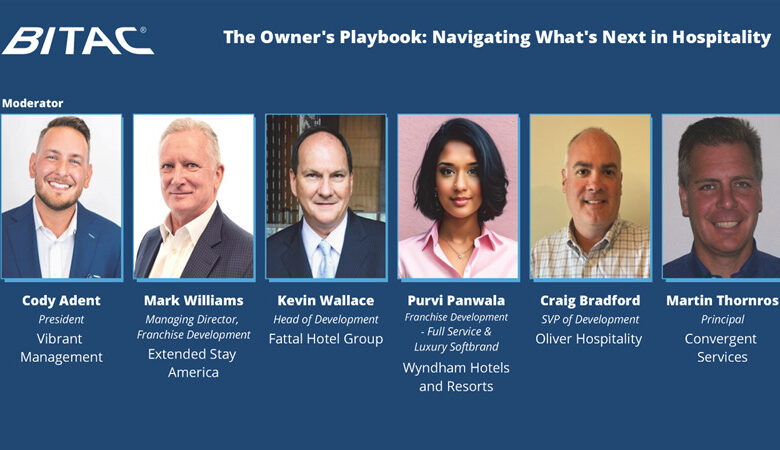
Moderated by Cody Adent of Vibrant Management, the discussion featured Mark Williams of Extended Stay America, Kevin Wallace of Fattal Hotel Group, Purvi Panwala of Wyndham Hotels & Resorts, Craig Bradford of Oliver Hospitality and Martin Thornros of Convergent Services.
Finding Capital in a Challenging Market
Market uncertainty has made raising equity particularly difficult this year, according to Bradford, who expects those challenges to persist into 2027. Oliver Hospitality, a boutique hotel operator that specializes in historic preservation projects, has had to get creative with its capital stack as average daily rates have remained stagnant in some markets.
For Panwala, a longtime hotel owner who now also represents Wyndham’s full-service and distinctive brands, securing financing has meant exploring avenues she hadn’t previously considered.
“I’ve definitely reached in pockets I’ve never reached in before and had conversations I never thought I would have,” she said. “But it’s what it takes to get it done.”
Relationships cultivated throughout her career have helped Panwala secure private equity when other financing was difficult to obtain. Conversations with industry colleagues also helped her explore financing opportunities through the EB-5 immigrant investor program.
Even companies with an established record of growth are encountering difficulties. Wallace of the Fattal Hotel Group, a major European owner-operator with more than 350 hotels, said he has found the economics of expanding into the United States more challenging than anticipated.
The company, which Wallace said grew its European portfolio in less than 10 years, has signed 10 hotels in the U.S. and expects to open a property in Manhattan in early 2027.
“We came over here, and I think, like a lot of foreign groups, we underestimated the challenges of entering this market,” Wallace said. “Particularly, cost of funds was a big surprise. It hasn’t dropped the way we’d hoped it would.”
High construction costs have further complicated the company’s expansion, despite its business model focusing on the renovation and repositioning of existing hotels rather than ground-up development.
Extended Stay: Competition and Conversion Opportunities
For Extended Stay America, the popularity of its own segment has become one of its biggest development obstacles. Major hotel companies that introduced extended stay products following the pandemic are aggressively pursuing development deals, often offering financial incentives that Williams said his company does not provide.
“I’ve lost deals because I don’t have key money, and they’re writing big checks. I’m talking big checks,” he said.
While key money has been used in hotel development for years, Williams said its prevalence has increased considerably over the past two years, with some of the largest hotel companies now offering incentives they previously had not.
He questioned whether the practice represents a viable long-term strategy, noting that the financial incentives come with obligations for owners.
“It always comes with a string,” Williams said.
Nevertheless, he remains bullish on the segment. Despite construction costs that he estimates are approximately 30% higher than during or before the pandemic, Williams said extended stay projects can still deliver strong returns for owners. He cited occupancy rates running 12 percentage points higher than those of transient hotels and anticipates several more years of development opportunity in what he considers an underdeveloped segment.
Extended stay properties also offer potential exit strategies beyond continued use as hotels. Williams pointed to examples in California where properties have attracted interest for alternative uses, including assisted living and homeless shelters.
Conversions could offer owners a particularly attractive entry point into the segment.
“You can go into a market, pick up something that is say $40,000 a key, put another $20,000, $30,000 in on renovation, and you’re still under market on a new construction,” Williams said.
By comparison, he estimated new construction costs for his company’s product at approximately $120,000 per key, at the low end. Competitors offering substantial development incentives may end up with newer hotels, he said, but those properties won’t necessarily be better positioned in their markets.
Acquisition opportunities aren’t limited to extended stay. Panwala sees potential for owners who have traditionally operated economy or midscale properties to move into segments that previously might have been financially out of reach.
“If you want to get into those full-service big boxes, now is the time to do it, and it might not happen again,” she said.
What Owners Can Afford to Cut
With limited ability to raise room rates in some markets, Bradford is looking to reduce spending on building infrastructure so more money can go toward finishes and amenities that distinguish a property from its competitors.
His approach is to seek out more economical solutions for essential mechanical, electrical and plumbing systems without sacrificing what makes a property appealing to guests.
“A guest does not care what is in the wall,” Bradford said, explaining that the emotional response a property elicits from guests is where he sees greater potential for a return on his investment.
Panwala faced some difficult decisions when a hotel project took considerably longer than anticipated.
“The timeline went way too long, and we had to make budget cuts, or else we wouldn’t be able to open, and we would run out of money,” she said. “Those are the facts.”
Growing up in the independent hotel business taught Panwala to be resourceful. At her family’s properties, even the envelopes that come in the mail are put to use again for cash drops. She explained that while such savings may seem negligible individually, they accumulate over the life of an operation, allowing owners to direct money toward things guests will appreciate.
But the distinction between necessary expenditures and unnecessary ones isn’t always apparent when it comes to building infrastructure.
Thornros, whose company specializes in low-voltage and IT consulting, has worked with ownership groups looking to spend as little as possible on technology while still satisfying brand standards.
“And we can do that,” he said. “[But] it’s a bad idea from a long-term perspective because you’re kind of cheating yourself in a way.”
Owners also must contend with the complexities of hotel IT procurement. Thornros has encountered instances in which hotels have been sold equipment that they don’t need or that adds no value to the property. At the same time, he said, pressure on IT vendors’ margins since the pandemic has contributed to a decline in the quality of some vendors’ work.
A recently opened Atlanta hotel on which Thornros and Bradford worked demonstrates why investing in the right infrastructure matters. The property has several food and beverage outlets, private dining and valet parking concentrated in and around its lobby. Both valet operations and point-of-sale systems rely on wireless connectivity, competing for network capacity with hotel guests and visitors patronizing the establishments.
Additional wireless access points were installed to accommodate the volume of users and bandwidth requirements.
The long-term implications of budget decisions were something Panwala had touched on earlier in the discussion.
“You don’t want to be cheap up front, where then later on it’s going to cost you more money,” Panwala said.
Finding a balance between immediate costs and long-term investment can be particularly challenging on conversion projects, where available capital may dictate the scope and timing of renovations. Panwala encouraged owners to have candid conversations with their brands about property improvement plans (PIPs) and establish realistic timelines for completing the work.
“Some of the PIPs are extravagant,” she said, noting that meeting those requirements in the current market can be particularly difficult when owners aren’t given sufficient time.
Wallace expects the proliferation of hotel brands, coupled with expenditures deferred during the pandemic, to prompt more scrutiny of how costs are allocated among owners, operators and guests. That includes determining who should bear the costs associated with programs such as guest loyalty initiatives.
Protecting the Top Line
For all the attention given to development and operating expenses, Wallace cautioned against relying too heavily on cost reductions to improve a hotel’s financial performance.
“Stay on top of your competition. Don’t mimic them. Don’t follow them. Be independent. Defend your top line,” he said.
In his experience, improving revenue performance is a more effective and less stressful way to strengthen a hotel’s business than trying to recover through cost cutting.
That doesn’t necessarily require more elaborate amenities. Wallace said he believes some budget and extended stay brands have done particularly well in delivering the fundamentals of a good hotel stay: comfortable beds, reliable showers and air conditioning that works.
Even at higher-end properties, guests sometimes struggle with something as basic as figuring out which switches control the lights in their rooms.
Owners looking to differentiate their properties can also find opportunities outside the hotel itself. Panwala pointed to community partnerships as a means of developing experiences that attract guests without necessarily requiring substantial financial investment. At one of her music-themed lifestyle hotels, for example, a partnership with a DJ academy enables guests to learn how to DJ.
Such arrangements, she said, can benefit both businesses while giving travelers another reason to choose a particular property.
AI and the Value of Development Experience
While much of the hospitality industry’s discussion about artificial intelligence has focused on hotel operations and guest services, Bradford sees another development worth watching: AI’s potential to change the competitive landscape for developers seeking equity.
The ability to produce sophisticated investment memorandums and presentations could make it easier for people with little hotel development experience to enter the market. Bradford anticipates that an influx of prospective developers pursuing the same sources of equity could make raising capital even more difficult for established companies.
The quality of those investment presentations, however, may have little bearing on the developers’ ability to execute complex projects or operate profitable hotels.
For experienced owner-operators, the consequences could present an interesting business opportunity within a few years.
“One of the areas that we’ve made our bread and butter is taking over properties that are run inefficiently and are set up inefficiently because people wanted to become hoteliers,” Bradford said.
Some of Oliver Hospitality’s best-performing properties, he said, are hotels the company has taken over and improved. He anticipates similar opportunities could emerge in two to three years if developments undertaken by inexperienced hoteliers fail to perform.
The competitive advantage, in Bradford’s view, will come from knowing how to apply the technology to the business rather than simply knowing how to use it.
“That edge with AI isn’t necessarily how can we write a good prompt,” he said. “It’s do we have the creativity and do we have the experience that goes behind the AI as a tool to really create great products as hoteliers?”
Preparing for a New Distribution Channel
Bradford also expects AI to have significant implications for how travelers discover hotels, potentially challenging the position of online travel agencies (OTAs) in hotel distribution.
He said he believes hoteliers have six to 12 months to begin adapting their marketing strategies.
“If I were an OTA right now, I would be shaking in my boots,” he said.
Making hotel websites accessible to large language models is part of the work, but Bradford believes the marketing implications extend well beyond a property’s own digital presence.
Understanding the kinds of questions travelers ask AI platforms about destinations and experiences will become increasingly important. Relationships with local businesses that recommend and promote a hotel could also play a role in making the property more visible.
For hotels accustomed to established digital marketing and distribution practices, Bradford anticipates that competing effectively in this environment will require a significant change in strategy.
Preserving the Human Element
As hotels invest in new technology, owners will need to consider whether those investments genuinely improve service or simply reduce the amount of interaction guests have with employees.
Front-desk kiosks, for example, could enable staff to spend less time processing arrivals and more time attending to guests elsewhere in the property. Whether that happens depends largely on how the operator chooses to deploy the technology, Panwala said.
“There’s a lot of hotels that might want to put kiosks at their front desk, right? And the point of that is so that you can give them a better guest experience somewhere else,” she said.
She sees finding the right balance between automation and personal service as one of the industry’s challenges in the coming year, particularly as travelers become more accustomed to using AI in their daily lives.
Williams offered a more skeptical assessment of customer-facing AI. He recounted his own experiences calling hotels and airlines, repeatedly asking automated systems to connect him with a live agent before eventually giving up.
Although he recognizes the usefulness of AI for writing correspondence and preparing presentations, he cautioned hoteliers against becoming overly reliant on the technology when dealing with customers.
“This is hospitality,” Williams said. “This is supposed to be happy. It’s not supposed to be frustrating.”