From the Hotel Interactive Newsroom | September 17, 2026
Independent hotels face many of the same financial and operating pressures as their branded counterparts, often without the scale, infrastructure or built-in distribution systems of a major flag. Even so, the lack of a prescribed playbook can also give independent owners and operators more freedom to pursue unconventional financing, partnerships and revenue opportunities.
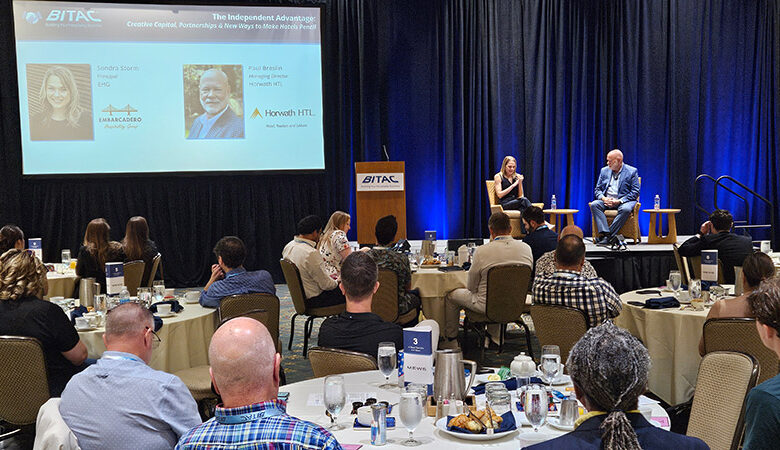
Sondra Storm, principal, CEO and co-founder of Embarcadero Hospitality Group, made that the focus of a recent fireside chat at BITAC® Independent 2026, held Aug. 23-25 at Arizona Grand Resort in Phoenix, Ariz. She was joined by Paul Breslin, managing director of Horwath HTL, who brought more than four decades of hotel operations, asset management and consulting experience to the conversation, “The Independent Advantage: Creative Capital, Partnerships and New Ways to Make Hotels Pencil.”
Storm opened the discussion by acknowledging the difficult realities that owners and operators currently face: Capital is expensive. Construction costs remain high and equity requirements have grown. Meanwhile, labor, technology, cost of goods and distribution continue to pressure hotel operations.
“For independents, some of those challenges can be amplified,” Storm said. “We don’t have the scale. Most often we don’t have the scale. We don’t have the infrastructure. We don’t have that streamline of central reservations coming through, and we don’t have that prescribed playbook that comes with a major brand.”
At the same time, she said that independence encourages a certain willingness to pursue projects in overlooked markets or develop concepts that do not fit established models.
“There’s a certain pioneering spirit that’s required,” she said. “We’re drawn to projects that are distinctive, to places that might often be overlooked, or ideas that don’t always fit neatly into an existing box, and increasingly the economics are requiring that pioneering spirit as well.”
Building a More Creative Capital Stack
For Storm, the flexibility of owning and operating an independent hotel begins with how the project is financed. She said Embarcadero Hospitality Group has opened four independent boutique hotels over the past seven years, and another two are entitled and in the pipeline. Several have been in rural or less-established hotel markets, requiring different approaches to financing.
“We’ve used public-private partnerships and public incentives,” she said. “We’ve raised higher levels of equity. We’ve worked with investors who have multiple bottom lines, where of course the financial return matters, but so do economic development goals, community impact, or even just the desire to create something meaningful in a particular place.”
Breslin agreed that creative financing can help move projects forward, but said the fundamentals can’t be overlooked. Location, timing, the right team and a realistic assessment of the economics still matter, as does finding the equity partners who can contribute something beyond capital.
“I believe equity has to add value, not just money, but they have to contribute to the success,” Breslin said.
Storm then turned the discussion to alternative financing tools, including Commercial Property Assessed Clean Energy financing, commonly known as C-PACE, EB-5 financing and tax incentives.
Breslin illustrated the point with a $500 million Miami development, Okan Tower. For the 72-story mixed-use high-rise, EB-5 financing represents about $10 million of the capital stack. The project also uses C-PACE financing.
Storm followed up with examples from Embarcadero’s portfolio. One rural development qualified for a USDA loan, while another project in the pipeline has both C-PACE and USDA financing. That project also secured a $10 million contribution from the city through a rebate of transient occupancy taxes over time.
“That was essential to making the capital stack, making the pro forma work, and an essential component of the capital stack,” Storm said.
Not Just ‘In It’ for the Incentives
As developers pursue public support, Breslin said, they should begin by understanding the goals of the municipality rather than arriving with a list of requests.
“Don’t just go to them and say, ‘What can you do for me?’” he said. “Understand what are their objectives, and have a relationship with them. You’d be surprised that they have some tools in their toolbox that you just don’t know about.”
He cited a resort project in Douglasville, Ga., where a portion of hotel-tax revenue helped support the project’s marketing for 15 years. Because the community did not have an established DMO (destination management organization), the arrangement created a source of marketing support for the hotel.
Tax abatements can also be meaningful, Breslin said, particularly when public incentives are what ultimately determine whether a project moves forward.
Storm added that independent hotels can find an advantage in those conversations because they can often be designed more closely around the character and needs of a particular community.
“Being an independent property too — there’s an authentic component to it where it really truly is of the place,” she said. “And I think that’s appealing to cities, but also more flexibility to participate and to really get involved in some of those community discussions.”
She recommended that developers study municipal strategic plans and community-vision documents before approaching cities so they can understand how a hotel project may align with existing goals.
Third parties can also play an important role in quantifying a project’s economic impact. Storm explained that Embarcadero has hired third parties to conduct economic-impact studies for its own projects. Those reports can quantify anticipated tax collections, increased property values, job creation and spending in the surrounding community.
Breslin said third-party validation can be particularly important when public officials are considering incentives or other support.
“The independent analysis from an impact study third party is critical because it gives the politicians and the community leaders cover that this is truly validated,” he said.
Turning Independence into Revenue
When the doors finally open, it’s the same flexibility that can help independent hotels get built that can also shape how they operate and generate revenue.
Breslin recalled reviewing the daily revenue report at Mr. C in Miami, a roughly 100-room independent hotel. He said it has approximately 25 revenue streams.
“How is that possible in a hotel? It’s because it’s independent,” he said. “It’s amazing how you can create revenue streams.”
Those opportunities extend beyond the traditional rooms, restaurants and bars to branded retail products and special-event merchandise, he said. “If you have read Conrad Hilton’s book, you know everything should be generating revenue,” Breslin said.
Thinking beyond the four walls of the hotel, Storm said independents can also create value through amenities and experiences they do not necessarily have to build or operate themselves.
She described one Embarcadero property located next to a city-owned meeting venue. Through a public-private arrangement, the hotel manages the venue rather than having to finance and build its own meeting space. At historic properties where adding a fitness center may not be feasible, the company has partnered with local gyms instead.
At a 22-room property in Wine Country, Storm said revenue more than doubled during the first several years after acquisition, in part because the company treated nearby wineries and related experiences as extensions of the property.
“The amenities are these relationships that we have with wineries and these one-of-a-kind experiences that we’re able to drive,” she said. “So, thinking about those things, they really can drive revenue and also save some expense in terms of what you’re designing.”
Partnerships Power the Off-Seasons
Storm said those partnerships become especially valuable in highly seasonal markets. One approach has been working with wineries to move events from periods when hotel demand is already strong into slower months. As an example, she described a wine event that shifted from July to February, creating a sold-out winter weekend for the hotel.
Another partnership involves a local supper club that holds events at the hotel. By packaging the event into a weekend experience, the property has been able to sell out dates that otherwise might have remained soft.
Storm also described collaborations that deepen a hotel’s connection to its market. At one dog-friendly property in Bend, Ore., the hotel works with local outdoor brand Ruffwear on pet amenities and with a local artist who creates portraits of guests’ dogs that are later mailed as postcards.
These examples, she said, illustrate how independent hotels can use local relationships for more than decoration or storytelling. Partnerships can become part of the operating and revenue model.
Seizing the Independent Advantage
As the session drew to a close, Storm reminded the audience: Independent operators need to understand why a particular hotel benefits from being independent and then use that autonomy deliberately.
“I think it always comes back to understanding why a project should be independent in the first place, and really leaning into that because there are really special things that we can do when we’re not tied to what is required in terms of the brand,” she said.
That flexibility, she added, can allow operators to put “the heart of hospitality and service and creativity at the front.”
“It is all about serving people and giving people these incredible, unique experiences,” she said.
***
Interested in speaking at a future event? To learn more about speaking opportunities, connect with the BITAC team here.
Follow BITAC Events on LinkedIn, Instagram and TikTok for event updates and highlights.