By Jacqui Barrineau | September 12, 2026
Mike Waring did not start Mustang Home Goods with hotel furnishings in mind. The company traces its roots to Waring’s own peripatetic past — he’s moved 27 times — and a practical problem that he tried to solve while stationed in Okinawa.
Years later, after leaving active-duty Navy service and working at a national laboratory in New Mexico, Waring turned to furniture making. Mustang Home Goods began as a small operation focused on one-of-a-kind solid-wood pieces. Over time, mockup pieces designed to test ergonomics and proportions were developed into the current plywood collection that now defines much of the business. And more recently, the business has “relaunched” with an eye on developing furniture solutions for the hospitality industry.
The shift toward designing pieces that could work for hospitality began when a man saw Waring’s furniture at an art show in Sedona and encouraged him to attend Glamping Show Americas in fall 2025. Waring says he went into the show thinking that he might be able to do some work with operators. Instead, he found several concrete business opportunities and discovered a limitation with his own production model.
A glamping tent company first approached Waring for furniture redesigned to fit inside its tents. (That work eventually became Mustang’s Wander line.) Then there was a discussion about the sale of 50 lounge sets. At the time, Waring was producing one lounge set a week in his garage shop.
“And that was already pushing it,” he recalls.
As the hustle and bustle of the trade show rolled on, another company asked to borrow pieces for its display. During the setup, someone mentioned they had access to a factory in Seattle if Waring ever needed to outsource production.
“I went from, ‘I’m going to be in the shop all day, every day for a year’ to ‘Wait, there’s potential to scale,’” he says.
One conversation led to another, and the scale of Waring’s business began to change. Faced with new opportunities and the challenges that went with them, Waring then spent six to seven months trying to figure out the manufacturing piece. In May, he traveled to Poland at the invitation of his plywood manufacturer. There, he began to explore possibilities for production for international markets.
His new goal began to crystallize: to move from making about four pieces a month himself — in his garage — to producing roughly 400 pieces a month at a factory.
While Mustang is currently an early-stage company, Waring is testing to see where its system fits. His aspirations have widened beyond developing furnishings for glamping sites. He now talks about hotel rooms and banquet furniture. Event-rental applications are also on his list. At the July 2026 BITAC Purchase & Design, he took in questions and real-world anecdotes that pushed him to think about storage and other hotel uses.
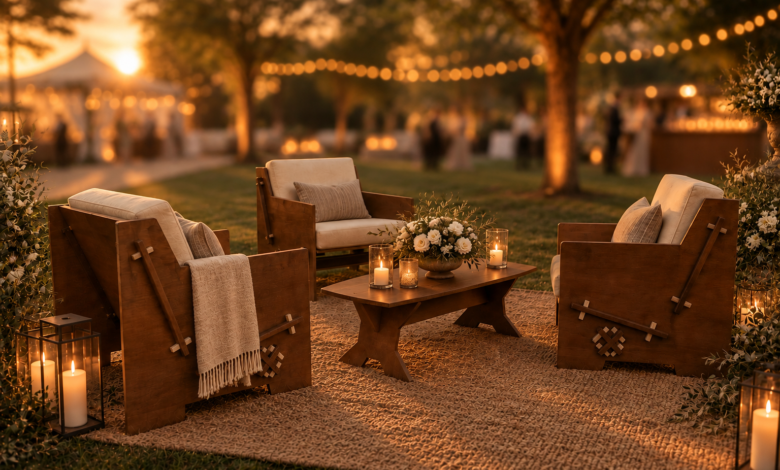
Although Mustang Home Goods furniture piques interest because of its flat-pack shipping, there’s more to the designs than just that. Waring is designing pieces that can be assembled without traditional hardware and can be taken apart and reassembled countless times. For hotel operations, that adaptability can offer solutions in spaces where cumbersome deliveries, installation time and limited back-of-house storage can complicate furniture moves.
In a recent Q&A with Hotel Interactive, Waring discusses the origins of Mustang Home Goods and the conversations and relationships that inspired him to envision an operation that extends well beyond the four walls of his garage. He also talks through what he is learning as the company moves deeper into hospitality.
This interview has been edited for length and clarity.
A Conversation with Mike Waring
HI: Your path to furniture design is unusual. How did you get here?
WARING: I joke that I’m a contender for Dos Equis’ “Most Interesting Man in the World.” I’ve moved 27 times, living in 13 states and four countries. I spent a year as a ballet performance major in college, then decided to join the Navy as a hospital corpsman. In 2006, I deployed to Iraq with a Marine infantry battalion.
I finished my undergraduate degree in public health in 2011 and accepted a commission in the Navy. I attempted to become a pilot. Instead, I became an industrial hygiene officer, a type of public health scientist and safety expert. After leaving active duty in 2020, I went on to work at a national laboratory in New Mexico.
During my VA mental health rating exam for PTSD, the doc shocked me by saying I should be at 100% disability compensation. At that moment, many of the challenges I had experienced in traditional work environments suddenly made sense.
Mustang Home Goods and my designs are conglomerations of the places I’ve lived and the experiences that have shaped me. The arts and sciences I’ve studied are part of that, too.
HI: You began making furniture while stationed in Okinawa. What problem were you trying to solve?
WARING: I first started making furniture with my dad when I was a kid. At 12, I designed and built my own bunk bed.
When I was stationed in Okinawa, I had a deck overlooking the ocean. I wanted furniture that was comfortable and could withstand Okinawa’s climate. It also had to be heavy enough that, during typhoons, I could simply tie it down instead of hauling it inside. So I built a couple of couches.
Several people told me that if I decided to make more to sell, they’d be interested in buying one. After my PTSD diagnosis, I realized I wanted to build something that could be part creative outlet and part therapy. It also needed to be a business.
Then another person saw those same couches, now sitting in my living room in New Mexico, and said they wanted one, too. That was when I decided that what had simply been a practical solution for my deck in Okinawa would become the project I wanted to build: Mustang Home Goods.
HI: How did the business begin to shift from one-of-a-kind solid-wood furniture?
WARING: The original version of Mustang Home Goods was meant to focus on one-of-a-kind, solid-wood luxury furniture inspired by the couches I built in Okinawa. The plywood collection started as nothing more than mockups to test ergonomics and proportions.
As I worked through the plywood designs, I realized I had accidentally created something I had wanted for years: Furniture that feels solid and permanent once assembled but can also be relocated without a box of missing hardware or hours spent taking it apart and putting it back together.
Initially, I was building everything myself out of my garage and sewing room. Last fall, I attended [Glamping Show Americas] and had several conversations that made it clear the business needed to scale up.
Instead of being the guy who could make four pieces a month in my garage, I would be the guy who made 400 pieces per month at a factory. As part of that, the solid-wood collection had to pause so I could focus on the CNC-cut, flat-pack plywood line. Those products could scale without sacrificing the design principles that inspired Mustang Home Goods in the first place.
HI: What makes Mustang’s flat-pack system different from the furniture people usually associate with that term?
WARING: Mustang’s flat-pack system was designed to be everything flat-pack furniture usually isn’t: It is solid and architectural. It is built to last.
The pieces are made from exterior-grade Baltic birch plywood, a structural material intended for decades of use. They lock together using pegged mortise-and-tenon joinery and compression-fit geometry. There are no screws to strip or hardware to lose. There is no bag of mystery parts sitting at the bottom of a moving box.
You can assemble a piece in minutes and disassemble it in moments. You can move it across the country and put it back together as many times as you want. It stays solid every time.
Most people hear “flat-pack furniture” and think of efficient shipping and warehousing. They also think of frustrating assembly and fragile disassembly. Tiny metal fasteners loosen or disappear, and particleboard panels simply aren’t designed to survive real life.
Mustang is different. It’s architectural furniture that just happens to ship flat.
HI: What do you see in hospitality that makes the Mustang system useful to operators?
WARING: Hospitality operators are always looking for ways to improve the guest experience. Furniture needs to be beautiful and distinctive. It also has to be durable enough to withstand constant use. Meanwhile, guests care if it’s comfortable.
Operators of glamping sites and boutique hotels are constantly balancing logistics and cost. Vacation rentals face many of the same issues. Saving money on shipping and reducing setup time are universal priorities.
The fact that we can ship hundreds of pieces of full-size furniture in a single container can change the economics of furnishing a property. A chair or bed can also be assembled in under three minutes.
At the end of a season, an entire glamping site’s worth of furniture can be packed back into a single container. If a hotel is in the path of a storm, outdoor furniture that would normally require multiple storage areas can be disassembled and stored in a single room.
HI: The Nomad Armchair was the first piece in the plywood collection. What does it show about how you design?
WARING: The Nomad Armchair was the very first piece I designed for the plywood collection, so in many ways, the entire line traces back to that chair. Frank Lloyd Wright challenged his students to build a chair from a single sheet of plywood. I didn’t know that when I designed the Nomad, but looking back, this would be my submission.
Every detail was intentional. That includes the angles of the seat and back as well as the placement of the arms. The stability of the structure mattered. So did the pegged mortise-and-tenon joinery and the tool-free assembly system. Even the direction of the wood grain on each component is deliberate.
The exposed plywood edges aren’t something I tried to hide. They’re a design choice rooted in my appreciation for honest materials and biophilic design principles. I also adapt those principles to feel right to my neurodivergent brain.
Furniture should be beautiful and functional. It should also be intuitive. It should feel solid and permanent when assembled yet adapt to the realities of modern life.
HI: Where do Prairie School architecture and Japanese craftsmanship show up in the furniture?
WARING: People have described my furniture as rustic. I was never comfortable with that label, but it took a while to figure out where exactly my design language came from.
People pointed out similarities to Frank Lloyd Wright furniture. I didn’t study furniture design before building my own, and I hadn’t even known Wright had made furniture. As I dug into design history, I realized it was Wright’s residential architecture, specifically the early Prairie School of Design, that shaped my design language.
You can see that influence in the strong horizontality of the pieces and the rectilinear forms. The lines are clean and intentional.
While stationed in Okinawa, I was amazed by the intricate joinery in historic Japanese building techniques and the simplicity of pegged mortise-and-tenon furniture. I deeply admire the craftsmanship woven into so much of Japanese culture, and I try to bring that same care to my own work.
New Mexico helped me understand why that instinct felt so natural. Much of the region’s best architecture embraces the textures and character of its surroundings. It reminded me that highlighting wood grain and structure isn’t a personal quirk here. It’s part of a long architectural tradition.
HI: What has been the hardest part of moving Mustang into commercial production?
WARING: As someone who started this company half as a therapy project and half as a business after 20 years in the military, there have been plenty of challenges. The biggest one is probably the same challenge every small-business owner faces: trying to do everything, everywhere, all at once, and mostly by yourself.
The transition from building furniture in a garage to operating at a commercial production level within a single year has been both amazing and complicated. The hardest part has been ensuring the factory pays the same attention to detail and craftsmanship it takes for the furniture to truly be Mustang.
The milestone that first made me feel Mustang was gaining real traction came at the Glamping Show Americas last year. The responses at High Point Market this spring reinforced that feeling. Conversations at BITAC Purchase & Design in Savannah this summer did, too.
This [growth] isn’t something dreamed up by the good-idea fairy. It was validation that Mustang is solving real problems and creating something the hospitality industry genuinely needs, and that I’m headed in the right direction.
What’s Next for Waring and Mustang
Waring is now working with the factory in Seattle and is exploring opportunities with European manufacturers that could eventually lead to the higher-volume output necessary to fill the big orders. As he navigates the next phase of his business, Waring’s product list is growing with hospitality applications in mind.
“I have a bunch of ideas,” he says.
Waring says he is working on the design for a modular walk-up service bar, and a banquet table system is also in development: Smaller tables that can stand alone can also be combined into a larger Grand Table.
During a recent follow-up call, Waring said he could see the system extending much further.
“I could outfit a hotel room,” he says.
On the logistics side, Waring says his furniture offers predictability and speed. For example, a 40-foot container can deliver 108 furniture sets, enough lounge seating for about 650 people, in a way that is very precise and easier to plan around on the back end. He estimates that the install itself takes about 22 man-hours, with a team of eight able to complete the physical setup in roughly three hours, not including unloading and positioning. In practice, that kind of efficiency can help operators reduce labor, compress downtime and get rooms or public spaces back in service faster.
The range of ideas extends into larger commercial pieces. Mustang already offers desks and dining furniture, but Waring also described a conference-table concept that’s approximately 10 feet wide and 25 feet long and weighs about 2,600 pounds. Using 50 mm Baltic birch plywood rather than the 18 mm material used in other pieces, the conference tabletop is designed in five 300-pound sections that could be moved through a doorway and brought up by elevator.
“You could host Riverdance on it,” he says.
He says the Seattle factory gives Mustang the flexibility to make custom pieces when a project requires them: “If they need a one-of-a-kind piece, we can do it.”
Looking further into the future, Waring wants Mustang to grow enough to provide meaningful employment for veterans, particularly those dealing with PTSD or transitioning out of military service.
“Creating opportunities for other veterans is absolutely part of the long-term vision,” Waring says.
For now, the company is still working out where the system fits best in hospitality. Waring’s own description of how he approaches the problem may also explain why that search is still expanding.
“I like puzzles,” he says. “I like finding ways to make things work in ways other people don’t think about.”
Clarification: This article has been updated to clarify that Mustang Home Goods currently offers desks and dining furniture.