BITAC Owners 2026: Growth Requires Planning Beyond Operational Challenges
From the Hotel Interactive Newsroom | November 24, 2026
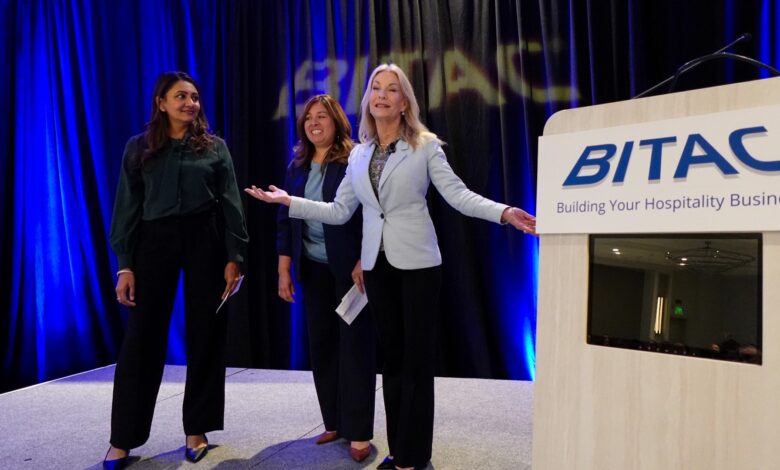
Newport Beach, Calif. — As hotel companies grow, keeping a strong culture intact and finding qualified employees only gets harder. Those were among the real-world challenges covered during a session at BITAC Owners Fall 2026, where Kimberly Rowell, CEO and managing partner of GOPAR Asset Partners, moderated a discussion that urged owners and suppliers to look beyond today’s challenges and prepare for what comes next.
The session, “Think Bigger, Commit Differently, Turn Ambitious Goals Into Action,” featured Zina Patel, owner of Anaya Hospitality Inc., and Melissa Garcia, vice president of communications at Mehr Consultancy. To expand the discussion beyond the panelists, Rowell used an interactive format to invite owners, operators and suppliers in the audience to identify obstacles to growth and consider potential solutions.
Rowell began with a deliberately expansive assignment — “think bigger, commit differently, turn ambitious goals into action” — but narrowed it to a practical question borrowed from hockey: Where is the puck going?
For owners, operators and suppliers in the room, that meant looking past the problems demanding attention today and considering what their businesses will require months or years from now.
The most immediate answers came from the audience.
Growth Puts Pressure on People and Culture
Doug Artusio, founder and CEO of Delisart Hospitality and chairman of the Extended Stay Lodging Association, pointed to culture as one of his company’s biggest challenges as its portfolio has expanded to roughly 100 properties.
“My greatest challenge is related to maintaining culture through growth, because we’ve been exploding,” Artusio said.
Delisart was founded 25 years ago and has tried to maintain what Artusio described as a family-style company culture even as the organization has expanded. The tenure of his executive team reflects that history: The least-tenured member has been with the company for 17 years.
Keeping that sense of belonging intact becomes more difficult as a company adds properties, people and layers of management.
For Armaan Patel of AGA Hotels, the constraint on further expansion is even more fundamental: finding people capable of operating hotels outside the company’s home market.
AGA has grown from about 10 hotels to 28, Patel told attendees, with its existing properties concentrated in Southern California. Geographic proximity makes those hotels easier for ownership to oversee directly. Expanding beyond that region has proven more difficult.
“The biggest challenge we’re having is finding good talent, good partners that will help us run the hotels,” Patel said.
The problem becomes more acute when ownership cannot easily visit a property.
“Getting boots on the ground and trusting people in this industry has been a pain,” he said. “I think that’s what’s holding me back from going out of the states.”
Rachel Overman of Insignia Hospitality Group Inc., which develops, owns and operates its hotels, described staffing problems that affect several stages of the business rather than hotel operations alone.
“Staffing is definitely our biggest opportunity at every point,” Overman said.
Labor shortages are reaching the development side because subcontractors are struggling with their own staffing, she said, while hotel operations face continued pressure as the company grows.
Accountability among existing employees also becomes more difficult as the organization expands.
“The culture piece is huge as we continue to grow,” Overman said. “Making sure that we’re keeping that culture — we like to think of ourselves as a family as well. So, [we work at] keeping that, maintaining that, not getting too big for our britches.”
By that point in the session, “culture” had surfaced repeatedly in answers from different owners and operators. Rowell connected those concerns to the systems and processes that companies put around their people, including technology that can make employees’ jobs easier.
But the audience responses also suggested that the term “culture” can become shorthand for several distinct growth problems: recruiting capable employees, trusting remote teams, maintaining accountability and preserving an organization’s identity as decision-making moves farther away from its founders.
Test Before Scaling
Growth also creates a practical problem for larger operators: Executives cannot personally know every product, technology or operating option entering the market.
Artusio described using individual hotels as testing grounds before making decisions across a portfolio, recalling a real-time opportunity to illustrate his point. After meeting several suppliers at BITAC Owners, he invited the general manager and director of sales from a nearby Irvine property to review products that might warrant a trial. “We should try them. We should test them for one hotel as relate to the rest of the company,” he told his team.
That approach offers a way to evaluate new ideas without committing an entire portfolio at once, he said.
“Just because we may have a lot of hotels doesn’t mean we know it all — because we just don’t,” Artusio said.
For executives consumed by financing, legal matters and day-to-day responsibilities, supplier conversations can expose operational possibilities they otherwise might not encounter.
“Sometimes I don’t know what I don’t know until I know it,” he said.
Planning Ahead Means Making Future Costs Visible
Several suppliers were asked to respond to the operating challenges raised by owners.
JB Ballinger of Commercial Fire offered one of the more direct examples: using information gathered during fire and life-safety inspections to forecast future expenses.
The company collects asset information as inspections are performed, Ballinger said, allowing operators to estimate spending requirements for the following year and potentially over a multiyear period.
For owners, that kind of visibility can convert an unpredictable operating expense into something that can be planned for in advance. For Zina Patel, the advantage of having those projections is the ability to budget accordingly.
“You know what the future holds — How much your expenses are going to be the following year or the year after that,” she said. “So, you could set aside your budget too.”
Other contributions showed how planning can extend beyond immediate expenditures.
Martin Thornros, whose company Convergent works with hotel technology and infrastructure, said technology decisions need to account for where hotel operations are headed, even though the precise future cannot be predicted.
The goal, he said, is to work with hoteliers so infrastructure being installed today can support their anticipated needs. That could mean planning three to five years ahead when developing a new hotel or undertaking an adaptive-reuse project, Rowell said.
When Operating Decisions Can Arrive Before Demand
Sometimes an owner needs to implement an operational change that may appear to be out of sync with current standards. To illustrate this point, Zina Patel recalled how changes in California regulations affected the adoption of bulk bathroom amenity dispensers.
Years before bulk dispensers became common, she had discussed dispensers with a supplier even though hotel brands and operators were showing little interest in them at the time. Regulations later pushed the industry away from single-use containers.
“And 10 years later, we’re using them,” Rowell said.
“We’re all using them from budget hotels to Marriotts,” Patel agreed.
Guest expectations and economics can also drive this type of industry shift. Even so, that does not mean every emerging product or service warrants immediate adoption. It does make early exposure to options valuable, particularly when owners can test or investigate them without committing immediately.
Relationships Need a Next Step
The session eventually returned to the mechanics of the BITAC Owners event itself.
Rowell urged attendees not to treat a 10-minute meeting as an isolated interaction. Her recommendation was simple: When there is reason to continue the conversation, schedule the next meeting before leaving.
Otherwise, she explained, owners and operators will return to properties, development work, financing and other immediate demands, while supplier follow-ups will fall behind more urgent problems.
“It’s not that we don’t care. It’s not that we don’t need you,” Rowell said to the suppliers in the room. “It’s that we are prioritizing the fires over where the puck is going.”
Garcia likewise encouraged attendees to reconnect after the event, gather references from other companies that have used a supplier and determine whether a relationship has practical value.
The value of those relationships may not become apparent for years. Rowell recalled meeting regularly with one industry contact at BITAC for some 14 years before they began doing business together.
For hotel owners and operators whose attention is consumed by the immediate demands of running their properties, maintaining those relationships, even in the absence of a pressing business need, can help lay the groundwork for future decisions.