BITAC Purchasing & Design: Where Design Meets Procurement
From the Hotel Interactive Newsroom | October 27, 2026
CARLSBAD, Calif. — Involving procurement teams earlier in hotel design and development can help owners avoid costly revisions, reduce delays and preserve the guest experience as material costs and supply chain uncertainty continue to complicate projects.
That approach requires a shift in how hotel projects are traditionally managed, with designers, procurement professionals and suppliers working together from the outset rather than completing their work in succession.
“Stop the relay game,” said Henri Munyengango, regional director of design strategies, Americas Design & Construction, for IHG Hotels & Resorts. “I think we have to all work together because that’s when you actually can influence the project the best.”
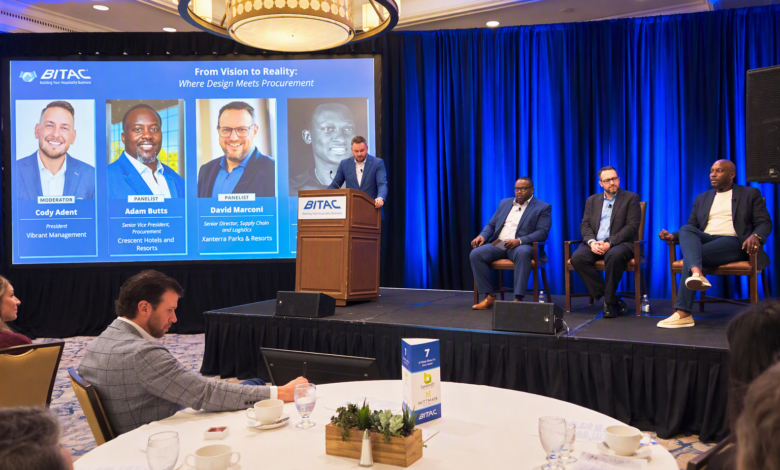
The need for earlier collaboration was a recurring theme during the panel discussion “From Vision to Reality: Where Design Meets Procurement” at BITAC Purchasing & Design Fall 2026, held Oct. 25-27 at Omni La Costa in Carlsbad, Calif.
Moderated by Cody Adent, president of Vibrant Management, the discussion brought together Munyengango, Adam Butts, senior vice president of procurement for Crescent Hotels & Resorts, and Dave Marconi, senior director of supply chain and logistics for Xanterra Travel Collection.
Drawing on projects ranging from branded hotel developments to historic national park properties, the panelists explored how owners and operators can balance design objectives with budget constraints, sourcing challenges and operational realities. They also discussed lessons learned from decisions that proved more expensive or complicated than anticipated.
Bring Procurement to the Table Earlier
Munyengango said IHG includes procurement in project discussions before design work begins, allowing teams to identify potential suppliers and understand cost expectations before specifications are finalized.
Without that involvement, designers can develop concepts that later require substantial modifications after procurement begins soliciting bids and suppliers evaluate the specifications.
He pointed to IHG’s work regionalizing the Ruby Hotels brand for the Americas as an example. After IHG acquired the brand in February 2025, Munyengango and the team had approximately seven months to develop brand standards, produce a mock-up, complete contracts and design a prototype guest room.
“We would not have been able to do that in seven months had procurement not been part of that discussion,” he said.
Butts agreed. When procurement teams are involved early, he explained, they can identify appropriate vendors and begin discussions before the design is finished. He said he is already working with owners on hotel projects that may be several years from development.
The approach can also reduce the number of suppliers under consideration. Although designers and owners sometimes prefer multiple sourcing options, usually because of tariffs, Butts said procurement teams generally favor working with a smaller group of suppliers.
“That eliminates a lot of back and forth,” Butts said.
Protecting Design Intent While Managing Costs
Deciding where to reduce costs without diminishing the intended guest experience remains a challenge, particularly when owners face uncertainty about project expenses.
Munyengango described how IHG has addressed those concerns within its Hotel Indigo brand, where the cost and time required to create individualized design concepts had become increasingly difficult for owners to predict.
After consulting design firms, suppliers and owners, IHG identified guest-room case goods and custom millwork as particularly time-consuming elements of the design process. The company then developed a strategy that involved standardized design elements that could be customized for individual properties, partnerships with procurement firms and training for design teams. The objective was to shorten development timelines while maintaining the brand’s design identity.
Munyengango said that prioritization extends to value engineering. Rather than treating every design element as equally important, he prefers to establish which features are essential to the guest experience and determine where spending can be adjusted.
“I used to get frustrated by the word ‘value engineering,’ but now I just call it ‘value allocation,'” he said.
That process begins with agreement among stakeholders about the intended guest experience, target costs and non-negotiable design elements.
“Because I found in the past when everything is weighed equally, everything’s expensive. So, you have to define what the non-negotiables are,” Munyengango said.
Butts described a similar need for clear decision-making authority when specified products must be substituted because of tariffs, availability or other sourcing challenges.
He explained that procurement teams can generally approve comparable replacements for smaller, non-guest-facing items while keeping the designers informed; however, guest-facing substitutions require design review, and decisions affecting brand standards or life safety should involve ownership.
“The swap itself has never really hurt the project,” Butts said. “What hurts the project is the arguing over who makes the final decisions and what happens.”
Establishing those responsibilities early, he said, can keep substitutions from becoming prolonged disputes that threaten schedules or budgets.
Lessons Learned from Past Projects
The panelists also reflected on past projects that demonstrated the consequences of overlooking practical considerations.
Marconi recalled a project earlier in his career involving a large glass chandelier specified as the centerpiece of a hotel lobby. The design team declined requests to change the fixture, leaving the procurement and logistics teams to repeatedly modify its packaging to accommodate shipping requirements.
“Big, big, big dollar logistics involved in shipping a big piece of glass,” he said.
Butts described a separate experience in which he repeatedly allowed a vendor to miss deadlines while trying to accommodate an owner and designer. When the product ultimately failed to arrive on time, the responsibility fell on procurement.
“The deadlines are there for a reason,” he said.
For Munyengango, one of the most consequential design lessons has been the need to consider how a property will function long after its opening. He cautioned the audience against designing primarily for portfolio photography because, he said, a visually impressive space may deteriorate quickly if its materials and furnishings cannot withstand everyday use.
Munyengango explained how his approach now includes spending more time with hotel employees, particularly housekeeping and food-and-beverage staff, to understand how they actually use the spaces that are being designed. He said those conversations can influence material selection, durability and maintenance requirements, all of which affect the total cost of ownership.
Munyengango also encouraged designers to work with suppliers who are willing to challenge their assumptions. “I want those actually who challenge me,” he said, “because I could have the best idea — but I don’t always.”
As an example, he described a supplier’s solution for Ruby Hotels’ signature wall paneling that helped improve constructability and control costs without sacrificing an important design feature. Because the brand frequently operates in urban conversion properties, traditional custom millwork could prove costly and difficult to install. Working with the supplier, the team developed a sectional wall-panel system that could be cut in the field while preserving the intended appearance.
Remote Properties: Logistical and Preservation Challenges
Marconi said Xanterra’s operations in national parks add two complications that most conventional hotels don’t face: geographic isolation and historic preservation requirements.
He described properties in Yellowstone, Grand Canyon and other national parks where nearby warehousing and installation labor can be difficult to secure.
“When you’re working in the middle of Yellowstone, your closest warehouse might be three or four hours away,” Marconi said.
The distance affects daily project logistics, including transporting supplies to job sites and securing installation crews willing to work in remote locations.
“Installers are our biggest challenge,” Marconi said.
According to Marconi, many Xanterra properties also operate under National Park Service agreements that require the company to maintain historic buildings and obtain approval for renovation plans.
At Old Faithful, for example, mineral deposits from the geyser can cloud historic windows. Marconi said the company has explored protective films as an alternative to repeatedly replacing the glass.
Seasonal closures add another layer of complexity. Buildings must be winterized and later reopened while preserving their historic architectural features.
Marconi also discussed Xanterra’s ongoing renovation priorities, including work at the Grand Canyon’s historic El Tovar property and improvements to employee accommodations.
With thousands of seasonal employees housed at its properties, Xanterra has prioritized employee living spaces and common areas as part of its workforce-retention efforts.
Market Volatility Remains a Planning Challenge
Looking ahead, Butts said fluctuating tariffs, freight costs and lead times are no longer unusual disruptions that procurement teams can address as isolated events. “It’s normal now. It’s something we have to deal with on a regular basis now,” he said.
That uncertainty requires procurement professionals to begin conversations earlier and communicate potential cost changes throughout development.
Butts noted that owners increasingly expect immediate answers about pricing and availability, even when those details depend on variables beyond the procurement team’s control. His approach is to identify risks at the beginning of a project and continue monitoring them as schedules and market conditions change.
Technology, including artificial intelligence, could improve access to information and support purchasing decisions, he said. But it cannot replace the experience of procurement professionals who understand suppliers and market conditions.
“As much as AI can help with the data technology, help making decisions, there’s nothing that beats the good judgment of a great buyer that understand the market,” Butts said.
Marconi added that technology cannot replace the relationships required to complete hospitality projects.
“Yep, and this is hospitality, and AI is not building those relationships,” he said.
Extend the Guest Experience Beyond Design
As the discussion concluded, the panelists returned to communication as a priority for owners and operators.
Butts encouraged hospitality professionals to develop a better understanding of responsibilities outside their own disciplines, including the financial risks faced by owners and the practical constraints confronting procurement teams.
Marconi similarly stressed the importance of managing expectations throughout the development process.
“We’re here to facilitate a process,” he said, describing the role of bringing stakeholders together and helping them understand the steps required to complete projects.
Munyengango offered a final consideration that extended beyond construction and procurement: the role of hotel employees in delivering the experience envisioned by designers.
He pointed to the front desk as a particularly important interaction, noting that guests arriving at a hotel may be tired or overwhelmed and looking for a welcoming environment.
“It doesn’t matter how beautiful your property is if your staff are not well trained to actually create that guest experience,” Munyengango said.
The responsibility for delivering on a hotel’s design objectives, he added, eventually shifts from the development team to the employees who interact with guests every day.
“After design, it’s really up to the property and the staff to actually really create the guest experience that we are seeking.”