Trends Change, Guests Don’t: BITAC Owners Panel Weighs Efficiency Against Hospitality
From the Hotel Interactive Newsroom | November 19, 2026
Newport Beach, Calif. — Hotels have more tools than ever to operate efficiently, but at what point does efficiency begin to erode the hospitality that guests are paying for?
That tension ran through a wide-ranging discussion Nov. 17 at VEA Newport Beach, where Greg Winey, CEO and president of Northpointe Hospitality Management, moderated the session “Trends Change, Guests Don’t.”
Winey structured the panel as a football-themed debate, with timed answers, a referee, penalties and points awarded for particularly strong responses. Rather than a discussion that ebbed and flowed toward consensus, the interactive format encouraged panelists to challenge one another on topics such as artificial intelligence, service levels, labor costs, brands, loyalty programs and online travel agencies.
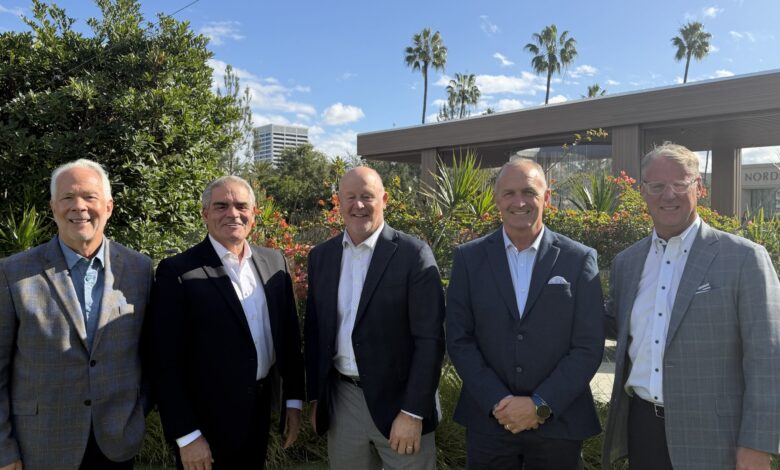
Joining Winey on stage were Russell Urban, CEO and principal of Electra America Hospitality Group; Tom Luersen, president of CoralTree Hospitality; Douglas Artusio, chairman and chief revenue officer of Dellisart Hospitality; and Guy Stehlik, founder and CEO of BON Hotels.
Before the discussion was in full swing, Winey looked back at a century of hotel-industry disruptions and changes in travel patterns. Citing examples that ranged from the Great Depression to post-COVID recovery, Winey posited that technology and business models have continually changed over decades, but guests’ basic expectations have remained remarkably consistent.
“Trends change. Guests do not,” Winey said. “They still want a clean room, a good bed, to feel safe, and here’s the big one: somebody who sincerely cares.”
AI Should Create More Time for Guests
Artificial intelligence provided the first test of that premise.
Urban described AI as a technology that has moved from an uncertain prospect just a few years ago to something affecting hotel design, operations, accounting and revenue management. He compared its impact with previous changes such as the internet and said hotel companies will need to adapt.
Luersen offered a slightly different view, explaining that the industry’s interest in AI is part of its continuing effort to find better ways to run a labor-intensive business while protecting margins.
“The AI toolbox now is just something that’s really available to us, and the smart person is understanding it and applying it without changing the thesis of our industry, which is service,” he said.
For Stehlik, the value of AI’s efficiency depends on where the saved time is actually spent. Hotels should use AI and automation to reduce administrative work, he said, so employees have more opportunity for direct guest contact.
Winey then flipped the question: What can AI not solve in the hospitality industry?
Luersen was quick to answer: “It’s not friendly. It doesn’t smile. It doesn’t connect. It doesn’t build relationships.”
That distinction between technology and human interaction became a recurring theme for the rest of the session.
Service and Hospitality Are Not the Same Thing
The issue crystallized as the panelists discussed service levels, with Stehlik drawing a distinction between service and hospitality. Service, he explained, delivers tangible standards, while hospitality is more about how a guest feels.
“When we look at hospitality, we at my company group it into three things,” he said. “Was I recognized? Was I valued? And did I feel welcome?”
Service scores may suggest that some hotel operations have improved, Stehlik said; however, he questioned whether hospitality has improved with them.
As an example, he described having breakfast at a four-star hotel where the food and physical setup met expectations but he had no interaction with an employee.
“The service was good,” he said. “But I left there with absolutely zero hospitality.”
Artusio added that he saw the same problem in operating practices that outlasted the pandemic. He said some service reductions introduced during that period have remained in place too long, pointing to reduced staffing and fewer amenities as examples of temporary cutbacks becoming accepted practice. He also questioned reduced housekeeping frequency at full-service hotels, particularly when room rates create a higher expectation of service.
“We have to get back to doing things right in somewhat of a traditional way,” Artusio said. “Many properties are still taking an easy way out. And it’s dangerous to the business.”
Winey then polled the room on whether hotel service today is better or simply more efficient. No hands went up for better service. The room overwhelmingly chose efficiency.
Labor Economics Complicate the Equation
But improving hospitality comes with a cost.
Artusio said hotel companies can use technology and operating data to improve scheduling and efficiency, but those systems do not necessarily tell managers how to deliver excellent service.
“Technology is great, but you have to use it as a tool,” he said.
For owners, however, greater efficiency does not eliminate the underlying investment. Urban noted that higher-quality labor costs more, as does incorporating the right technology into hotel operations. Owners may absorb some of those costs initially, he said, but a sustainable hotel business still has to produce an adequate return.
Stehlik questioned whether the industry’s post-pandemic cost reductions have produced the financial improvement some operators expected, saying research he had reviewed showed that hotel EBITDA had not improved simply because staffing and operating expenses were cut.
The same pressures shaping labor costs are also beginning to reshape the jobs themselves, raising another question: Which hotel jobs are most vulnerable as AI becomes more capable?
Luersen pointed to call-center and reservation functions as areas already beginning to change. By contrast, he expects some form of front-desk or guest-contact position to remain because hotels still need human interaction at arrival and departure.
“I believe that we’re always going to have that human touch upon arrival and at the farewell experience,” he said.
Brands and Loyalty Still Have to Earn Their Cost
As the conversation moved from hotel operations, the panel examined the value that owners receive from brands.
Stehlik said major hotel companies face the difficult task of maintaining consistency across growing brand portfolios without allowing individual brands to become indistinguishable. He also said owners should continue asking whether brand fees are justified by financial performance.
“Brands have to earn their fees,” he said.
And flags have to fit a particular asset, market and business plan, Urban added, noting that soft brands can preserve more of a hotel’s individual identity.
Building on Urban’s point, Luersen said owners still have to determine which affiliation makes sense for a particular property. “There are certain markets where a brand can be just outstanding, and then there’s other markets where perhaps it’s not as relevant,” he said.
The same value-versus-cost question surfaced around loyalty programs.
Stehlik said guests may be loyal less to a brand than to the points and perks that come with its loyalty program, questioning whether they would return without benefits such as early check-ins, late checkouts and upgrades. At the same time, he described those programs as an important way for hotels to counter the OTAs and maintain a direct relationship with customers. Even so, for owners, he said, the financial equation still has to work: Loyalty programs should generate enough incremental profit to justify marketing royalties, distribution costs and brand fees.
Some of those costs may eventually make their way to the guest, Urban added. Owners may bear those costs first, he said, but he expects at least some to be reflected in room rates over time.
What’s Next for OTAs?
When Winey asked whether hotels could ever free themselves from online travel agencies, the panel split.
Luersen said OTAs are likely to remain part of hotel distribution. In the upper-upscale and luxury segments, particularly in urban markets, he said they can provide important demand even as hotels continue trying to drive more bookings through their own channels.
“I think they’re here to stay,” Luersen said.
“I’m going to go on the other side and say their days are numbered,” Artusio countered.
He credited OTAs with becoming highly effective at reaching consumers but predicted that major hotel brands, backed by significant financial and technology resources, will develop stronger ways to compete for that business directly.
Urban landed on the same side of the argument, calling OTAs a viable but expensive distribution channel. He said he expects the major brands to continue making progress against them.
Winey shifted the discussion to a lightning round of questions about 2027, limiting responses to one word. All four panelists predicted RevPAR growth above 2%. Three favored keeping resort fees, while Stehlik said they should go. Winey briefly paused game play to ask him why.
“Any charge that is voluntary shouldn’t be mandatory,” he said.
Winey then made his own case for the fees, offering parking fees as an example of a predictable source of revenue. “We have variable income every night,” he said. “We have no idea what we’re going to charge, but I sure as heck know I’m going to charge you $30, $40, $50 bucks for parking. It is [guaranteed] income, and it’s really hard to detach yourself from that.”
As the last question of the session, Winey asked what owners should do before 2027 budgets are finalized. The panelists had 30 seconds each to draw on themes that had surfaced throughout the session: organizational buy-in, customer input, employee engagement and closer scrutiny of guest-acquisition costs.
After Stehlik was named the first BITAC Bowl champion, Winey closed by returning to his opening premise: Technology, brands and operating models will continue to change, he said, but the hospitality business will still depend on whether guests feel welcome, valued and cared for.
“A hundred years from now, nobody will care about the software we use,” Winey said. “They’re going to care about how you treated people.”